The motor, board, power, safety devices and controls that move your driveway gate, repaired on the driveway. Same day.
Tell us what the door is doing. The estimate is free either way.
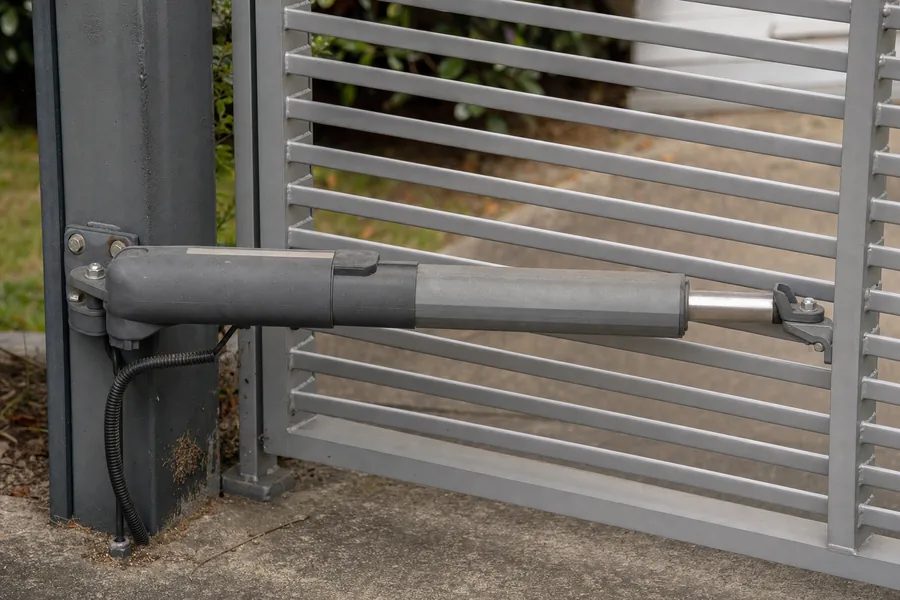
The gate is the easy half. The operator is the motor, gearbox, control board, power supply and the safety devices that let it move a few hundred pounds of steel next to a driveway without hurting anyone. When it hums, clicks, opens halfway or ignores the remote, that is the half we are looking at on this page, for Irving and the towns around it.
Swing arm operators, slide gate operators on chain or rack, underground swing units, solar and hardwired. We carry boards, batteries, capacitors, limit switches, photo eyes and receivers for the common makes, so the first visit is usually the repair.
Six things account for nearly every operator call we take. In the order we see them:
A hardwired operator runs on a transformer and behaves like a garage door opener. A battery backup unit keeps going through an outage. A solar unit is a battery with a panel to feed it, and it needs sun, a clean panel and a battery under five years old. We work on all three, and we will say plainly when a solar setup was never going to keep up with the traffic on a driveway in Irving.
Most no-power calls are simple: a tripped breaker, a transformer that has failed, low-voltage wire chewed or cut by a mower, or a fuse holder gone green. The visit starts at the incoming power and works towards the board, so the board is never replaced when the fault was a fuse.
A gate operator installed to the current standard carries monitored entrapment protection: photo eyes across the opening, contact edges on the leading edge, or both, and the operator will not close if any of them is unhappy. Half of the calls that start as 'the gate is broken' end at one of these. We align, clean, rewire or replace them, and we never bypass one to make a gate close.
A gate that closes without working safety devices is a gate that can trap a car or a child. If yours has been wired around, we put the protection back before anything else.
Linear arm swing operators, the ram-style units on most residential double gates. Articulated arm units where the post is set back. Underground swing operators hidden at the hinge. Chain-drive and rack-and-pinion slide operators, from small residential units to heavy commercial gates. Solar and battery kits from the big-box brands.
The parts differ, the method does not: power, board, limits, safety devices, motor, controls, in that order.
Once the gate moves, the controls are the next call. Remote receivers lose range with a corroded antenna. Keypads drown. Telephone entry systems stop dialing when the line changes. Phone-app kits need their hub alive. We re-code, replace and rewire all of it, and we leave every remote in the house working before we go.
A new receiver often fixes the 'short range' complaint outright, and it comes with the visit for the common makes.
One call books a two-hour window and the technician arrives with the parts the phone description suggests.
A board, a battery, a capacitor, a photo eye or a receiver is a repair and it is what most calls are. An operator is replaced when the gearbox is worn out on a unit nobody makes boards for any more, when it was undersized for the gate from the start, or when water has been living in the housing for years. We say which on the driveway, and the free estimate covers both.
A new operator on a gate that drags lasts one season. If the gate is the reason the motor died, the hinges or the track get fixed first, and that work is on the gate repair page.
LiftMaster and Chamberlain gate operators, Nice and Apollo, US Automatic, Viking, DoorKing, FAAC, Eagle, All-O-Matic, Elite, Ramset, Mighty Mule and Ghost Controls, and the solar kits sold in Irving hardware stores. Boards, batteries, receivers, photo eyes and limit switches for the common models ride with the technician.
hail and heat, plus heavy daily cycling in Las Colinas rentals. For an operator that means a housing that bakes in summer and fills with condensation in winter, a battery that works harder at both ends of the year, and a solar panel that needs cleaning after every dusty spell.
The seasonal pattern in Irving is steady: batteries and capacitors in the heat, photo eyes and boards after storms, frozen arms and dead batteries in the cold. We stock for the season we are in.
Look at the operator's power light. Check the breaker and, on a solar unit, whether the panel is clean and in sun. Look for a spider web or a dead bug across the photo eye lens. Try a second remote. Press the gate by hand a few inches with the operator released: if it is heavy, the gate is the fault. None of it is required; all of it helps the phone call.
What not to do: do not bypass a safety device, do not run the motor repeatedly against a stuck gate, and do not open the operator housing on a mains unit.
Both. Operator repairs are most of the work, and the gate itself is handled by the same crew when it is the reason the operator failed.
On an AC operator that is almost always the start capacitor, a small carried part. On a DC unit it is a low battery or a gate that has got too heavy to move. Either way it is a first-visit repair.
Nine times in ten it is a photo eye or safety edge doing its job for a bad reason. We test each device in turn rather than guess.
Yes. Battery, charge controller, panel connections and the operator itself. Most solar calls are a battery past its life or a panel in shade.
All the common makes and most of the uncommon ones. The board, safety devices and controls follow the same rules on every brand.
No. A safety device that is holding the gate open is doing its job, and the repair is to fix it, which is nearly always quicker than the argument. We put bypassed devices back before anything else.
Most days. A gate stuck open is a security problem and the schedule keeps room for it.
Around Irving, one call gets you a two-hour slot and a heads-up call before the technician sets off. We don't buy leads and nobody on a phone judges a door they can't see.
Free estimate across Irving, TX and the towns around it.
We give a two-hour window rather than a day, and we call before setting off. Free throughout Dallas County. The estimate is free either way.
Would rather call? Call (972) 597-8723.
Tell us what the door is doing. The estimate is free either way.